
Data Privacy and Audit Evidence Challenges: If It’s Not Auditable, It’s Not Usable



In the first two articles, we explored where AI fits in the audit lifecycle and the regulatory risks emerging from its use in financial environments.
The next question is more practical: can AI-driven processes meet the standards required for data protection and audit evidence?
In many organizations today, the adoption of AI into audit and finance is expanding through small decisions made under pressure rather than formal transformation programs.
-
A controller pastes a dataset into a generative AI tool to accelerate variance analysis.
-
An audit associate uses AI to draft testing documentation when timelines tighten.
-
A finance manager uploads customer contracts to extract revenue terms.
These actions reflect a broader, quiet shift in how AI is being used in workflows across enterprises.
What is often missing from this adoption pattern is the alignment with other requirements of audit and not the awareness of AI’s benefits. Audit is not simply about producing answers faster or automating processes; it is about producing conclusions that can be traced, validated, and defended.
When AI is introduced without being anchored to those requirements, organizations begin to create a structural gap between how work is performed and how it must ultimately be evidenced.
This gap is becoming increasingly visible in the data.
Recent studies show that 8.5% to 13% of employee prompts to generative AI tools contain sensitive data, including financial records, customer information, and internal documents. The exposure is not limited to misuse, nearly 40% of files uploaded into AI tools contain personally identifiable or regulated data.
At the same time, adoption continues to accelerate, with reports indicating that up to 68% of employees use AI tools through unsanctioned or “shadow” channels, often outside governance frameworks.
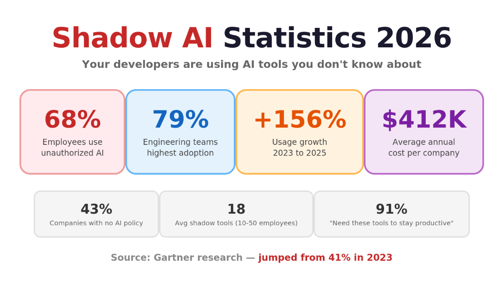
Source: Second Talent. (2026), Top 50 Shadow AI Statistics 2026: Real Data on Hidden AI use. Link
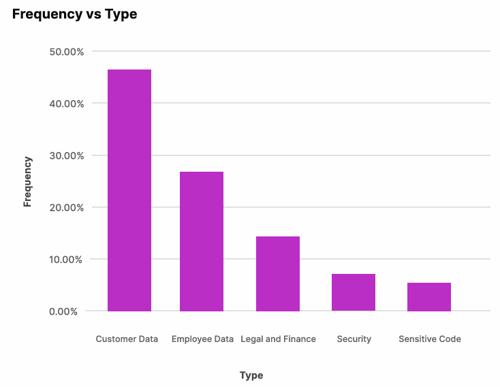
Source: Second Talent. (2026), Top 50 Shadow AI Statistics 2026: Real Data on Hidden AI Use. Link
These numbers highlight a clear issue: AI risking Data privacy. It is already reshaping how financial data moves inside organizations, but governance and audit frameworks have not evolved at the same pace.
Where data privacy risk becomes operational
The first issue arises when data exits controlled environments. In traditional audit workflows, data typically remains within defined systems such as ERP platforms, secure analytics tools, or controlled audit environments. These systems are governed by access controls, logging, and clear accountability.
AI changes that boundary.
Generative AI systems operate across distributed infrastructure, often outside the organization’s direct control.
When employees input financial or client data into these systems, several risks arise simultaneously. Data may be processed in external jurisdictions, stored temporarily in logs, or even used to improve models depending on configuration and licensing terms.
In some cases, AI tools can even reconstruct or infer sensitive information from seemingly benign inputs due to their ability to combine and analyse data at scale.
Real-world incidents prove how quickly this risk materializes. In 2023, a software bug in ChatGPT exposed parts of users’ data, including chat history titles and payment information of some subscribers.
The issue is not always caused by malicious intent. It is that AI makes it extremely easy to move sensitive data across uncontrolled environments in seconds, often with no visibility.
The deeper issue: Breakdown of audit evidence
Although data privacy risk is immediate, a fundamental challenge lies in the nature of the evidence in audit.
Audit requires a clear chain of what data was used, how it was processed and how conclusions were reached and AI disrupts this chain in multiple ways.
Research on AI governance highlights a growing concern around lack of reproducibility and traceability in AI outputs. This is making it difficult to verify or re-perform results independently.
Unlike traditional analytical tools, AI outputs can change based on prompt design, system updates, or underlying model behaviour. This variability introduces uncertainty into processes that rely on consistency.
Regulatory and audit bodies are already signaling that this gap is critical. Frameworks such as NIST’s AI Risk Management Framework and emerging regulatory standards emphasize that organizations must be able to demonstrate who processed what data, under which policy, and with what outcome, on a continuous basis. Static documentation or one-time outputs are no longer sufficient.
This results in fundamental tension. AI is most effective at generating insights quickly, but audit is designed to validate processes thoroughly. When those two capabilities are not aligned, the output may be useful for decision-making but insufficient for audit reliance.
How this manifests in real audit scenarios
The implications become clearer when viewed in the testing phase.
A finance team using AI to review contracts can significantly reduce review time. However, without documented logic or traceable processing steps, the result cannot be relied on as audit evidence. It becomes an input into analysis, not a basis for a conclusion.
Similarly, audit teams using AI to draft documentation often produce outputs that appear complete and well-structured. Yet, subtle inaccuracies or assumptions can be introduced by the model. Without a verifiable connection to underlying testing procedures, the documentation risks failing under scrutiny.
Even in data analytics, where AI adds the most value, the issue persists.
For example, an AI model may generate anomaly detection output that highlights real risks. However, auditors cannot independently validate the conclusion if the methodology cannot be reproduced. As a result, additional procedures are required, often reducing the efficiency gained.
The scale of the gap: A structural issue
The challenge is not limited to isolated use cases. It reflects a broader structural shift in how audit environments operate.
The chart below summarizes how AI affects key audit requirements:
|
Audit Requirement |
Traditional Systems |
AI-Driven Workflows |
|
Data control |
Internal, governed |
Often external or hybrid |
|
Traceability |
High (logs, systems) |
Limited or inconsistent |
|
Reproducibility |
Deterministic |
Variable outputs |
|
Documentation linkage |
Direct |
Often indirect |
|
Regulatory alignment |
Established |
Evolving |
This shift helps explain why AI-related incidents increased by over 56% in 2024 alone, reflecting a widening gap between adoption and control.
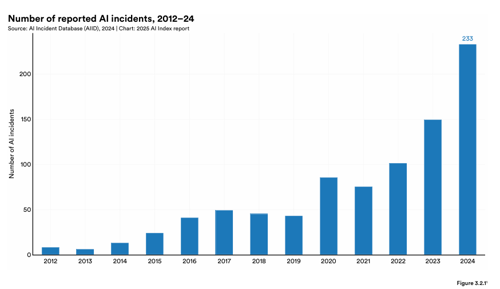
Source: Stanford Institute for Human-Centered Artificial Intelligence (HAI). (2025), Artificial Intelligence Index Report 2025. Stanford University. Link.
Implications for Decision-Makers
Executives should immediately take action to formalize how AI is used in audit and finance.
First, restrict all sensitive financial and client data to be approved and secure AI environments by eliminating the use of public tools for audit-related work.
Second, enforce a clear rule: AI outputs support analysis but they do not qualify as audit evidence. All conclusions must be transparent, testable, and supported by evidence.
Third, require full traceability by documenting inputs, prompts, and outputs for any AI-supported activity.
Finally, integrate AI into existing control frameworks (SOX, ICFR, SOC 2) and monitor its usage actively.
The priority is not adoption speed; it is defensibility under audit and regulatory scrutiny.
Conclusion: A shift from outputs to evidence
AI is already integrated in audit and finance and its value is clear: it accelerates analysis, expands coverage, and reduces manual effort. But it challenges one of the core principles of audit: that conclusions must rely on evidence that is traceable, reproducible, and defensible.
The best organizations are not rejecting AI; they are structuring their use of AI exactly around that.
Others are moving just as fast, but without that discipline. They are building speed into their process and risk into their conclusions.
The gap between those two approaches will show up in audits, in regulatory reviews, and in board-level accountability.
And when it does, only one standard will matter:
If it’s not auditable, it’s not usable.
In the next article, we move one level deeper and examine how AI is being applied to internal controls, and why “smarter controls” can sometimes create weaker assurance.
Subscribe to get the future series of the article
Mondaq LinkedinSubscribe for our latest insights
Sign up for more of our thought leadership and analysis—sent straight to your inbox.
Sign Up

