
Regulatory Risks of Using AI in Financial Environments



Many organizations assume that increased efficiency translates to better control and stronger compliance as AI usage increases across audit workflows. The logic holds up: if AI improves accuracy, accelerates processes, and expands analytical coverage, then it should naturally reduce regulatory risk, right?
This assumption overlooks how financial regulators evaluate decisions. Regulators are not concerned with the speed a conclusion is made, or whether it’s automated. They concern themselves with whether these conclusions hold up under scrutiny.
In regulated environments, efficiency is irrelevant if the conclusion is not accurate.
When AI is introduced without reinforcing governance and oversight, it weakens the integrity of the insights produced. As a result of this, organizations may accidentally increase their regulatory exposure rather than reduce it, negating efficiency gains.
Reality: Regulatory Expectations Remain the Same
This dissonance in understanding creates the impression that AI works in a regulatory grey area. It does not. Regulators are standing firm; regulations apply regardless of whether processes are manual or automated.
Organizations remain fully accountable for AI-generated outputs in exactly the same way they are for human decisions. This includes expectations around data confidentiality and privacy, recordkeeping, audit evidence, documentation, and internal controls over financial reporting.
Frameworks such as CAS 230 (Audit Documentation) and CAS 500 (Audit Evidence), along with PCAOB expectations, continue to require sufficient, appropriate, and well-documented evidence to support conclusions.
In fact, AI does not simplify compliance obligations, it increases them. Regulators are now paying closer attention to model governance, data traceability, and the validation of automated outputs, increasing the level of scrutiny applied to financial processes that use AI.
Where the regulatory risk actually emerges
As regulatory expectations remain unchanged, our focus turns to the places where risk increase. From an audit and risk perspective, AI introduces challenges across confidentiality, compliance, and audit defensibility.
These risks are not theoretical; they arise directly from how AI systems are implemented within financial workflows.
Confidentiality risk emerges through the uncontrolled movement of sensitive data. AI systems require extensive datasets. These include customer records, contracts, general ledger extracts, and other financial information. This data is frequently uploaded into third-party tools, processed through cloud-based environments, or integrated into external platforms.
What’s so concerning is that organizations often lack insight on this data is stored, how it is processed, or whether it is retained or reused. Teams may adopt AI tools independently, without fully grasping vendor environments or data handling practices, leaving data exposed. This directly conflicts with regulatory expectations around data security.
Compliance risk arises from the increasing complexity and opacity of AI-driven decision-making. Unlike traditional deterministic systems, AI models adapt, relying on inaccurate training data, and produce inconsistent outputs. If an AI model produces a result, can an organization verify it, if so, how?
Regulators expect companies to test systems before deployment, monitor outputs, and detect anomalies. However, many organizations rely on AI outputs without formal validation or ongoing monitoring. The jump between AI outputs and regulatory expectations may remain unseen until a failure occurs.
Audit defensibility is one of the biggest risks in financial environments. While compliance focuses on validation, audit defensibility requires clear explanation. Every financial conclusion must be proven by traceable evidence, reproducible processes, and documented reasoning.
Many AI systems operate as “black boxes,” meaning the decision process is unclear even when input and output is observable. Regulators, however, require auditors to explain the reasoning behind their conclusions and the evidence supporting them
As our audit team added: “The PCAOB has acknowledged these risks, noting that AI outputs can contain inaccuracies or biases, and that the engagement team member who uses a GenAI tool remains fully responsible for the results and documentation of the work. Supervisors reviewing such work are expected to apply the same level of diligence as when reviewing work where AI was not involved.”
This underscores a critical regulatory expectation. If a decision cannot be explained, reproduced, or proven, it is not valid audit evidence.
Audit Process Comparison
An illustration of how AI introduces additional layers within the audit process, where control, traceability, and evidence can break down.
|
STEP |
TRADITIONAL PROCESS |
AI - ENABLED PROCESS RISK |
|
Data Collection |
Controlled internal data |
Unclear sources |
|
Processing |
Defined rules |
Model-driven, non-transparent logic |
|
Testing |
Manuel, traceable |
Automated, partially hidden |
|
Evidence |
Fully documented |
Output without full trace |
|
Conclusion |
Clearly supported |
Harder to defend |
Implications of AI in Auditing for CEOs, CFOs, and Boards
These risks reshape the control environment of financial functions. Every AI implementation introduces its own set of challenges. Organizations must now manage new systems and evolving risks which require governance and documentation.
Transparency is now at the forefront of regulatory exposure. If an organization cannot describe how AI is used, where it is used, and how results were produced, it fails at audit defensibility. As a result, auditors are increasingly focused not just on outcomes, but on the processes that produce them.
Despite this, AI adoption is moving faster than the development of governance frameworks. Many organizations are embedding AI into financial reporting, audit procedures, and decision-making workflows before establishing appropriate controls. Regulators are placing increasing emphasis on this issue, recognizing it as a risk in compliance and reputation management.
Our audit manager added, “From a standards perspective, the fundamental requirements under CAS 230 (Audit Documentation) and CAS 500 (Audit Evidence) remain unchanged, audit evidence must still be sufficient and appropriate, and documentation must clearly demonstrate the basis for the auditor's conclusions. The use of AI does not reduce or alter these requirements in any way.”
Real-World Example: How AI Is Used in Audits Today
We can already see the impacts of these risks. In 2023, Samsung employees inadvertently leaked confidential data through ChatGPT while attempting to debug internal issues. Sensitive information was uploaded to a third-party with no visibility or control over its use. They later banned the use of AI tools. This incident highlights how quickly confidentiality risks can arise when AI adoption outpaces governance.
Similarly, Apple’s credit card algorithm assigned wildly different credit limits to clients with similar financial information. When questioned on this, the response was that the result was determined by the algorithm. In the domain of audits, being unable to explain the production of outcomes is inexcusable.
As seen in these examples, without transparency and accountability, AI-predicated decisions cannot meet the regulatory standards of financial environments.
Regulatory Risks of Using AI in Financial Environments: What Companies Should Do
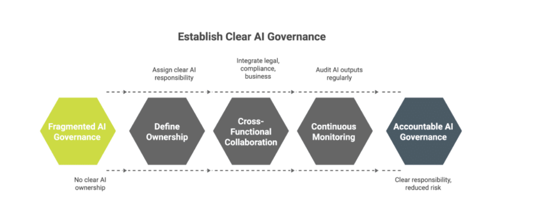
Given these challenges, organizations must shift their focus from adoption to regulation. This starts with stating where AI is used and demonstrating accountability for its financial outputs. Organizations must ensure that responsibility remains taken, even when AI is involved.
Data governance must also be strengthened. Sensitive financial information should be carefully controlled, with clear policies on when and where it is used with AI and external vendors. Vendor risk assessments and data classification should become standard practice before AI integration.
There is now an increased need for validation and monitoring. AI systems should not be treated as inherently reliable; their outputs must be tested, proven, and readily monitored for inconsistencies. Organizations should maintain documentation of how models are used, how outputs are generated, and how decisions are supported.
Lastly, AI should not be treated as a separate capability, rather integrated with existing frameworks. This means including AI systems within internal controls, ensuring they are subject to testing, and aligning them with regulatory requirements for evidence.
AI Governance Action Framework
To translate these risks into practical steps, organizations need clearly defined control actions across each area:
https://orases.com/blog/ai-becomes-infrastructure-who-owns-risk/
Takeaway: AI Adoption Requires Governance
When properly governed, AI can improve efficiency by enabling larger data sets to be used and recognizing patterns more quickly. It has the potential to improve how financial analysis is performed and how risks are identified.
However, efficiency is not everything. Regulations remain unchanged; decisions must be controlled, documented, and valid, whether AI is involved.
Ultimately, success does not come down to the speed of AI implementation. It belongs to those who ensure its use are controlled, compliant, and defensible.
Subscribe to get the future series of the article
Mondaq LinkedinSubscribe for our latest insights
Sign up for more of our thought leadership and analysis—sent straight to your inbox.
Sign Up

