
When Should You Outsource Your Finance Function?



"“If your finance team is reacting instead of forecasting, you're already behind.” "
— PKF Antares
In most growing companies, finance doesn’t break — it quietly falls out of sync. At first, it shows up in small ways. Reporting takes longer than it used to. Numbers require more explanation in meetings. Questions about the future — hiring plans, expansion, pricing — don’t get clear answers right away. Nothing feels urgent. But over time, decision-making slows down. Leadership starts relying more on instinct than data, not by choice, but because the finance function isn’t keeping pace with the business anymore.
This is the real issue: growth has changed the demands on finance, but the structure hasn’t caught up.
The Breaking Point: When Finance Stops Supporting Decisions. The shift usually happens gradually.
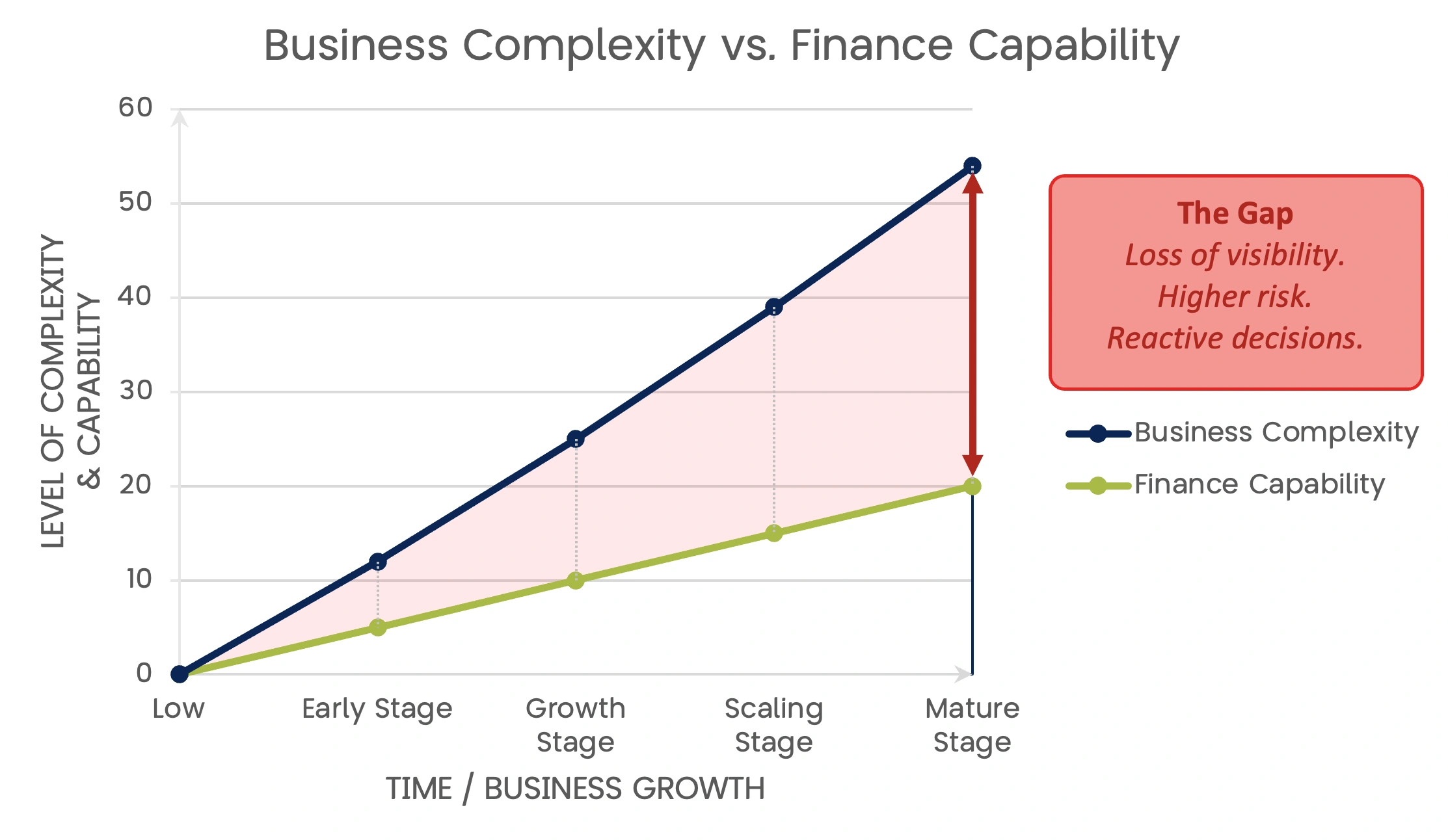
What used to be a clean month-end process becomes stretched and inconsistent. As the business grows, more transactions, more variables, and more complexity are layered onto processes that were never designed for that scale. The team works harder to keep up, but the output doesn’t necessarily improve.
At the same time, the nature of questions changes. Leadership no longer just wants to know what happened — they want to understand what’s likely to happen next. And that’s where the gap becomes visible.
You start to see patterns like:
- Reporting cycles extending further each month
- Forecasts that exist but aren’t actively used
- Cash flow that feels reactive instead of planned
- Increased reliance on manual workarounds
Individually, these issues are manageable. Together, they signal something more important: finance is no longer driving clarity — it’s trying to keep up with complexity.
Why In-House Teams Struggle to Scale
This isn’t usually a talent issue. In most cases, the team is capable — but built for a different stage of the company.
A finance function that works well at an earlier stage is typically designed around accuracy and compliance. As the business grows, the expectation shifts toward interpretation, planning, and strategic support. That’s not just an incremental change — it’s a different type of capability.
The challenge is that companies often try to bridge this gap by hiring incrementally. They add more capacity, but not necessarily the right level of insight. Or they hire senior talent without the supporting structure underneath, which limits their effectiveness.
Over time, a few structural issues tend to emerge:
- Too much reliance on a small number of individuals
- Processes that exist informally rather than being standardized
- Reporting that depends on effort instead of systems
What this creates is a finance function that can keep operating, but struggles to evolve. And as the business becomes more complex, that gap becomes harder to ignore.
What Outsourcing Actually Means
One of the reasons companies hesitate to outsource is that the term itself is vague. It often gets interpreted as a single solution, when in reality it’s a way to build out missing layers in the finance function.
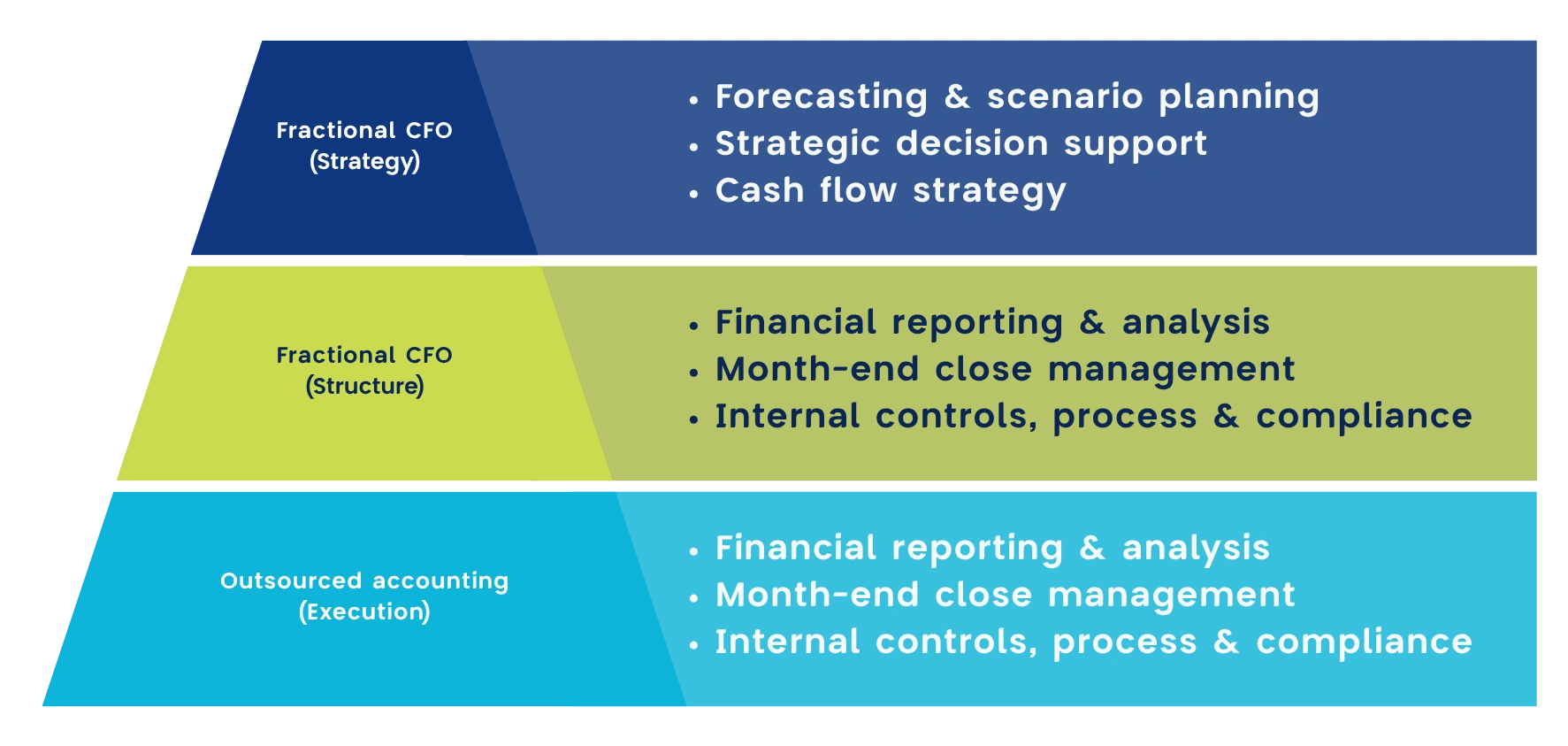
At the foundation level, outsourced accounting ensures that the numbers are accurate and up to date. It handles the transactional side — recording activity, reconciling accounts, closing the books. Without this, nothing else works. But on its own, it doesn’t provide insight into the business.
The next layer introduces structure. Controller-level support focuses on how information is produced and presented. It brings consistency to reporting, ensures that processes are followed, and makes the numbers reliable. At this stage, finance becomes stable — but still largely focused on explaining past performance.
The real shift happens when strategic capability is added. A fractional CFO builds on top of this foundation by focusing on what the numbers mean for the future. This includes forecasting, scenario planning, and helping leadership understand the financial impact of decisions.
To simplify the distinction:
- Outsourced Accounting → keeps the numbers accurate
- Controller → makes the numbers reliable and structured
- Fractional CFO → makes the numbers useful for decisions
Understanding this separation is critical. Many companies try to solve a strategic problem with an execution-level solution — and end up frustrated when clarity doesn’t improve.
When You SHOULD Outsource Your Finance Function
Outsourcing becomes relevant at the point where internal structure can no longer keep up with the demands of the business.
This often happens during periods of growth, when complexity increases faster than visibility. Revenue may be rising, but confidence in the numbers isn’t improving at the same pace. Decisions start getting made with partial information, which introduces risk even when performance looks strong.
Another common trigger is external pressure. Preparing for investment, dealing with lenders, or going through an audit changes expectations quickly. Financial information needs to be more structured, more defensible, and more forward-looking. If the existing setup wasn’t designed for this, the gaps become visible almost immediately.
Cash flow is another area where the need becomes clear. It’s not always about having enough cash — it’s about understanding timing and predictability. When surprises become more frequent, it usually points to a lack of oversight rather than a lack of data.
In many cases, it’s a combination of factors:
- Growth outpacing reporting capability
- Increasing demands from external stakeholders
- Limited forward-looking visibility
- Dependence on a small number of individuals
At that stage, outsourcing is less about optimization and more about restoring control and clarity.
When You SHOULD NOT Outsource
There are also situations where outsourcing adds little value. If the business is still early, with low transaction volume and limited complexity, the need for layered financial support isn’t there yet. In these cases, adding external structure can create unnecessary overhead without improving decision-making. Outsourcing becomes valuable when there is enough complexity to justify it — not before.
The Real ROI: What Actually Changes
The impact of outsourcing is best understood not in terms of cost, but in terms of how the business operates. When financial reporting becomes faster and more consistent, decisions don’t get delayed waiting for clarity. When forecasting is actively maintained, leadership can evaluate different scenarios instead of reacting to outcomes. When controls are stronger, risks are identified earlier rather than after the fact.
This leads to a shift in how the business functions:
- Decisions become more structured and less reactive
- Planning becomes more deliberate
- Financial discussions become clearer and more focused
Over time, this compounds into better performance — not because costs are lower, but because the quality of decision-making improves.
Common Traps to Avoid
Recognizing the need to evolve the finance function is one step. Acting on it effectively is another. A common mistake is trying to solve the problem by adding junior resources. This increases capacity, but doesn’t address the lack of insight. The volume of information grows, but clarity doesn’t improve. Another is delaying action. Many businesses try to stretch their current setup as long as possible. It often works — until the issues become too complex to fix quickly. There’s also a tendency to approach outsourcing as a cost decision, which leads to choosing providers focused only on execution. While this can improve accuracy, it doesn’t solve the underlying need for structure and strategic input.
In most cases, the root issue is a lack of clarity around what’s actually needed — whether it’s better execution, stronger control, or strategic guidance.
Final Thought
Finance doesn’t usually fail outright. It falls behind — gradually — until the gap between the business and its financial visibility becomes too large to ignore.
Outsourcing, when applied correctly, is not about replacing what exists.
It’s about adding the missing layers that allow finance to function at the level the business now requires.
If your finance function is starting to feel reactive instead of proactive, that’s usually the signal that something needs to change.
Connect with our Finance Professionals
Subscribe for our latest insights
Sign up for more of our thought leadership and analysis—sent straight to your inbox.
Sign Up

